
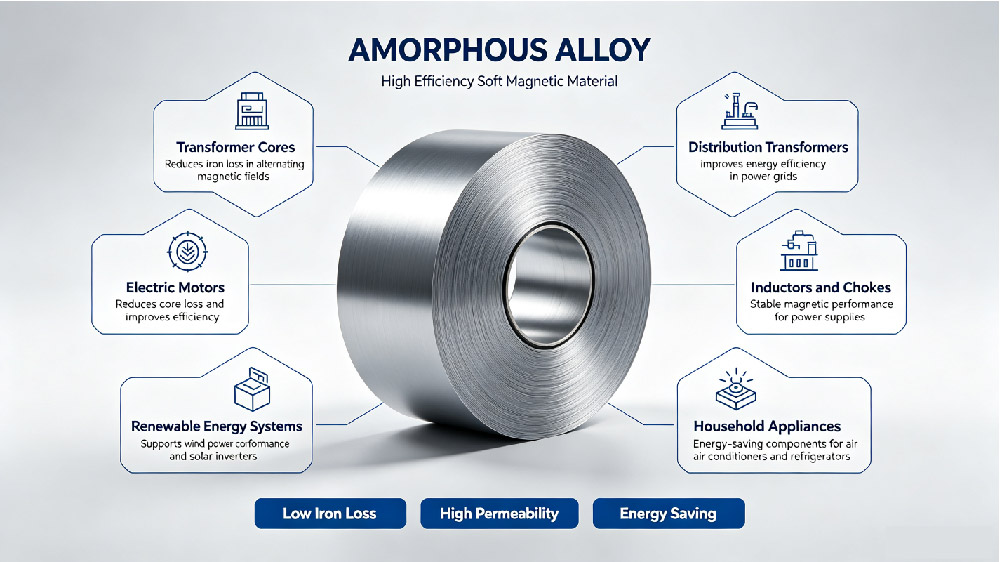
In the field of amorphous alloy research, amorphous alloy core transformers are transformers with cores made of amorphous alloy. Compared to transformers with silicon steel laminated cores, their no-load losses are reduced by approximately 75%, and their no-load current is reduced by approximately 80%. Amorphous alloy strips have a low loss rate, and their use in new types of distribution transformers helps reduce power consumption. Unlike traditional silicon steel sheets, amorphous alloys are brittle after stamping and difficult to form into laminations; therefore, the winding process is commonly used in practical applications. In recent years, the use of amorphous soft magnetic materials in electric motors has gradually increased, and their low iron loss characteristics have attracted attention from the academic community. In the field of electric drive systems for new energy vehicles, the application of amorphous alloys has also shown great potential; their high magnetic permeability and low loss characteristics help improve motor efficiency and power density.
In addition to the already common applications that leverage the excellent electromagnetic properties of amorphous materials, new materials have emerged that utilize the unique properties of amorphous alloys, such as strength and hardness. What is amorphous metal used for? These amorphous metal materials may play a significant role in the following fields in the future.
1. Aerospace Sector: By leveraging the superior mechanical properties—such as high specific strength and specific stiffness—of bulk amorphous alloys, they can be used to manufacture structural materials for aerospace vehicles, including main frames, structural trusses, bearings, and mirror mounts. This can significantly reduce weight, which is equivalent to improving the thrust-to-weight ratio of aircraft engines.
2. Military Weapons: Because bulk amorphous alloys exhibit extremely high dynamic fracture toughness under high-speed loading and possess excellent self-sharpening properties when penetrating metal, they are among the preferred materials for armor-piercing projectile cores. Currently, Zr-based amorphous alloys under development can achieve a fracture toughness of up to 60 MPa·m¹/², making them the most superior armor-piercing projectile core material discovered to date. At the same time, the high hardness of bulk amorphous alloys makes them suitable for use as armor-piercing protective materials, such as in armor and bulletproof vests.
3. Precision Machinery and Automotive Industries: By leveraging the characteristics of the amorphous structure, high-precision, defect-free micro-gear transmission mechanisms can be manufactured; their high hardness and wear resistance enable the production of wear-resistant components in automotive engines—such as hydraulic cylinders and pistons—significantly extending their service life.
4. Chemical Industry: By leveraging their resistance to corrosion by various media, large blocks of amorphous alloys can be used to manufacture corrosion-resistant components, significantly extending their service life.
5. Medical and Sports Equipment: The corrosion resistance of bulk amorphous alloys makes them the material of choice for fracture splints and pins; their excellent specific stiffness, specific strength, and high hardness make them ideal for high-level sports equipment such as horizontal bars, parallel bars, and pole vaults. Bulk amorphous alloys have also been successfully applied to the striking surfaces of golf club heads.
6. Other Applications: Their excellent chemical reactivity enables the production of superior catalysts for chemical reactions and photocatalytic materials; their superior soft and hard magnetic properties make them upgraded alternatives to traditional magnetic materials; and their unique physical properties, such as thermal expansion characteristics, can be utilized to manufacture various precision components and thermal bimetallic devices with higher sensitivity. Furthermore, their superplasticity at specific temperatures enables superplastic deformation and processing.



Consequatur et culpa accusamus ea. Incidunt velit dicta doloremque repellat quo magnam
Reprehenderit dolor non tenetur aut. Quam error dolore harum. Qui aliquid perferendis aut recusandae iusto. Exeid fuga aspernatur est dolores. Et facilis alias nihil nostrum et Exercitationem perspiciatis qui sit Consequatur vel ut placeat esse aut.