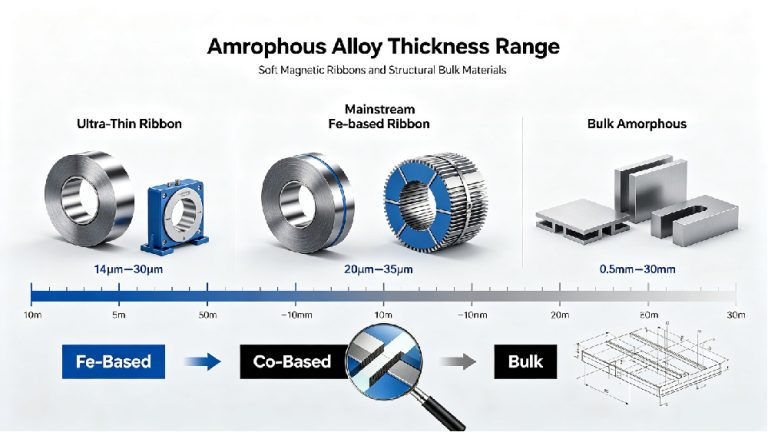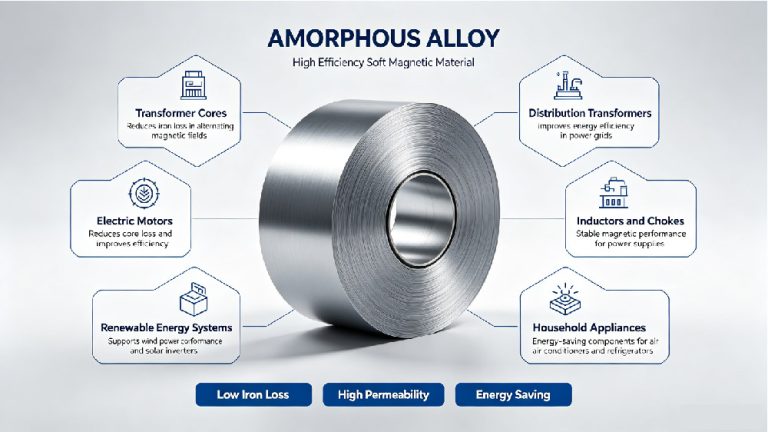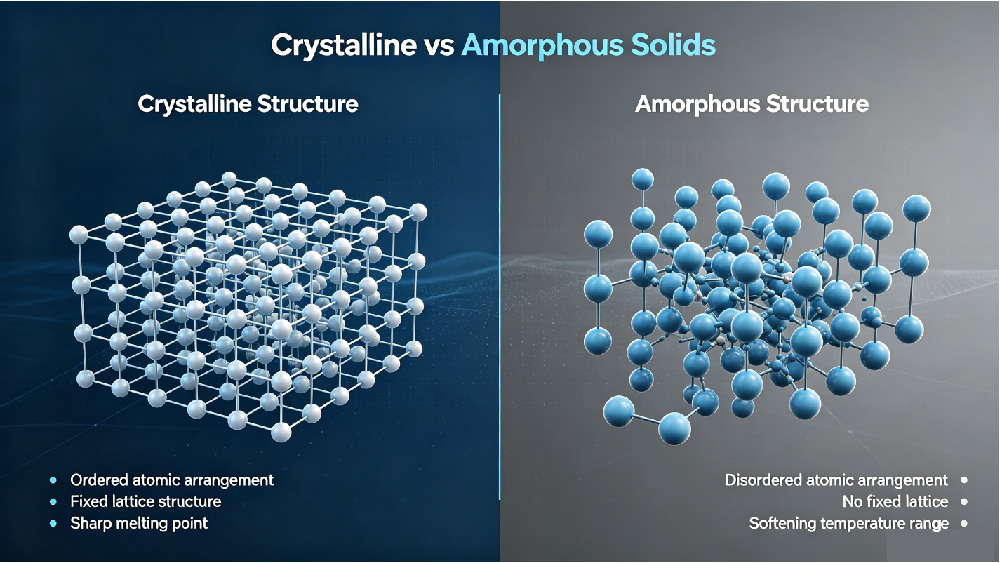
The main difference between crystals and amorphous materials lies in whether their internal atomic arrangements are orderly; this directly results in differences in their melting points, shapes, and physical properties. In crystals, atoms are arranged in an orderly, aligned pattern, similar to a line of people; they have a fixed melting point, and their properties vary depending on the direction. In amorphous materials, atoms are arranged randomly; they do not have a fixed melting point, and their properties are the same in all directions. Crystals are typically formed through slow solidification, sublimation, or crystallization from a solution, giving atoms sufficient time to align themselves. Amorphous solids are mostly produced through rapid cooling, during which atoms are frozen before they have time to arrange themselves in an orderly manner—for example, amorphous alloys (metallic glasses).
5 Differences Between Crystalline And Amorphous Solid:
1. Internal Atomic Arrangement
– **Crystals**: Atoms are arranged in a regular, periodic, and orderly manner, forming a fixed, well-defined lattice structure (silicon steel and common metals are both crystals)
– **Amorphous solids**: Atoms are arranged in a random, disordered pattern with no fixed lattice; their structure resembles “frozen liquid” (amorphous alloys, glass)
2. Melting Point Characteristics
– **Crystals**: Have a fixed, well-defined melting point; they melt uniformly only when heated to a specific temperature
– **Amorphous solids**: Have no fixed melting point; when heated, they continue to soften and gradually flow, exhibiting only a softening temperature range
3. Anisotropy (Directionality of Physical Properties)
– **Crystals**: Anisotropic; magnetic permeability, hardness, thermal conductivity, and electrical conductivity vary depending on the direction (a typical characteristic of oriented silicon steel)
– **Amorphous materials**: Isotropic; magnetic, electrical, and mechanical properties are uniform in all directions
4. X-ray diffraction characteristics
– **Crystals**: When exposed to X-rays, they produce clear, regular diffraction spots or fringes
– **Amorphous**: Only diffuse, blurred broad diffraction rings appear; no sharp diffraction peaks
5. Energy and Stability
– **Crystalline**: Lower internal energy; more thermodynamically stable
– **Amorphous**: Metastable; higher internal energy; will slowly crystallize under prolonged high-temperature conditions, resulting in changes in performance