
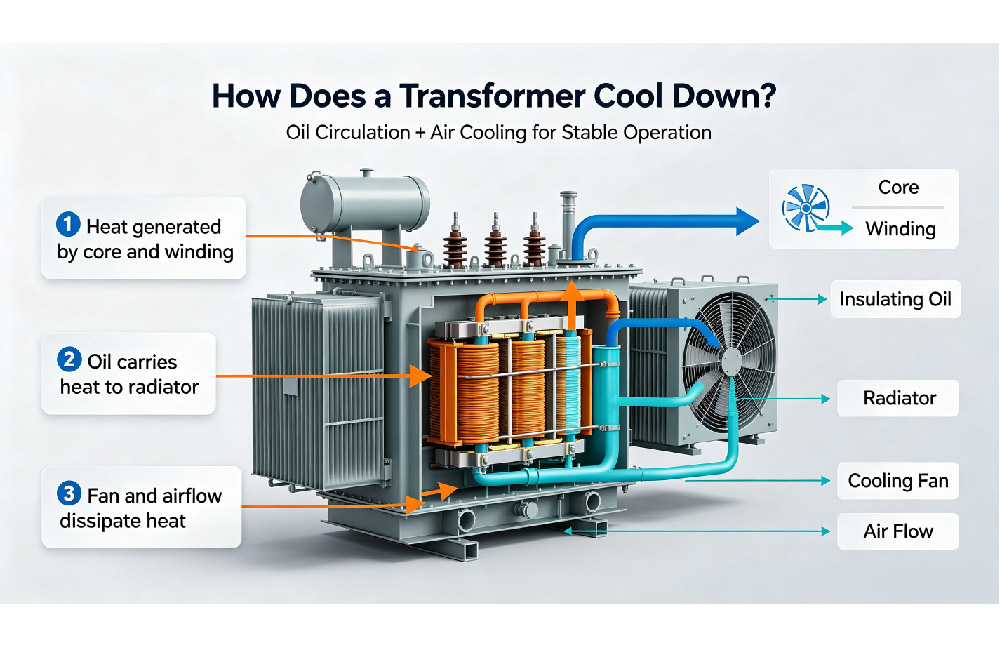
Transformers are common and critical components in power systems, used to regulate voltage levels and facilitate the transmission and distribution of electrical energy. During operation, transformers generate a certain amount of heat; therefore, effective cooling measures are necessary to ensure their proper operation and extend their service life. This article will introduce common transformer cooling methods and explain how does a transformer cool down.
- Transformer Cooling Methods
1.1. Natural Cooling (AN – Air Natural)
Principle: Heat is dissipated through natural convection and radiative heat transfer, without the need for additional auxiliary equipment.
Advantages: Simple, reliable, and energy-efficient.
Disadvantages: Highly susceptible to environmental conditions; relatively low heat dissipation efficiency.
1.2. Forced Air Cooling (AF)
Principle: Air circulation is forced by fans or ducts to accelerate the heat dissipation process.
Advantages: High heat dissipation efficiency and good stability.
Disadvantages: Requires additional energy consumption and has slightly higher maintenance costs.
1.3. Oil Cooling (ON)
Principle: Insulating oil is used as the cooling medium, and the transformer is cooled through oil circulation and radiators.
Advantages: High heat dissipation efficiency, good insulation properties, and low environmental requirements.
Disadvantages: Complex oil temperature control; requires periodic oil replacement and maintenance.
1.4. Oil-Forced Cooling (OF)
Principle: Combines oil cooling and air cooling technologies, utilizing oil circulation supplemented by fan-assisted cooling.
Advantages: High heat dissipation efficiency and good stability.
Disadvantages: Slightly complex oil temperature control; higher maintenance costs.
1.5. Water Cooling (WW – Water Wet)
Principle: Uses water as the cooling medium, with water cooling equipment installed inside or outside the transformer.
Advantages: Extremely high heat dissipation efficiency and low energy consumption.
Disadvantages: High installation and maintenance costs; strict water quality requirements.
- How to select the transformer Cooling Method
2.1. Load Type
Light Load: Natural cooling or oil cooling can be selected.
Heavy Load: Forced-air cooling or water cooling is recommended to ensure efficient heat dissipation.
2.2. Environmental Conditions
High-Temperature Environments: High-efficiency cooling methods, such as forced-air cooling or water cooling, are recommended.
Humid Environments: Oil cooling or oil-air cooling is recommended, as these methods have low environmental requirements.
2.3. Maintenance Costs
Economic Considerations: Natural cooling and oil cooling are relatively simple and have lower maintenance costs.
Efficiency Considerations: Although forced-air cooling or water cooling have higher maintenance costs, they offer greater heat dissipation efficiency and stability.
2.4. Reliability Requirements
Long Service Life: Oil cooling and water cooling typically offer higher heat dissipation efficiency and stability, making them suitable for scenarios with high reliability requirements.
2.5. Resource Availability
Adequate Water Supply: If water is readily available and of good quality at the installation site, water cooling may be considered.
2.6. Overall Considerations
When selecting a cooling method, it is necessary to comprehensively consider multiple factors—including load conditions, environmental conditions, maintenance costs, efficiency requirements, reliability requirements, and available resources—to make the most suitable choice.





Omnis tempora non omnis asperiores eveniet velit consectetur
Nulla vitae reprehenderit quia incidunt incidunt auted placeat facere et veniam
Thank you so much for your time and effort in reading this.
Commodi eos voluptatem laborum esse. Beatae aliquid rerum perferendis atque impedit nostrum