
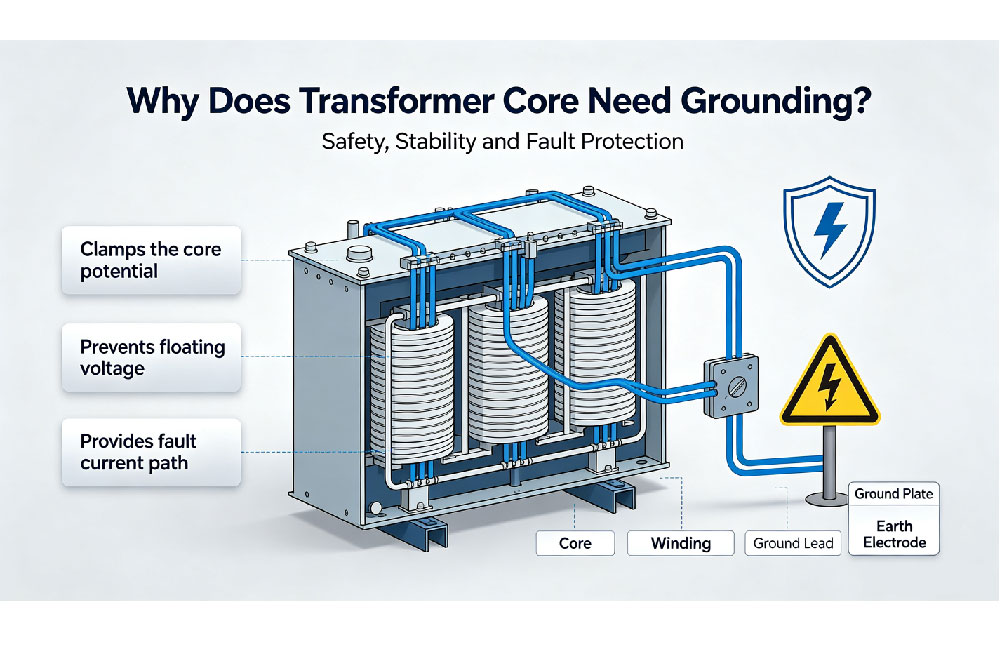
Why Does Transformer Core Need Grounding?
Whether it is intermittent discharge caused by potential differences or continuous micro-discharge resulting from the breakdown of very small insulation gaps, neither is permissible; moreover, it is extremely difficult to locate the sites of these intermittent discharges.
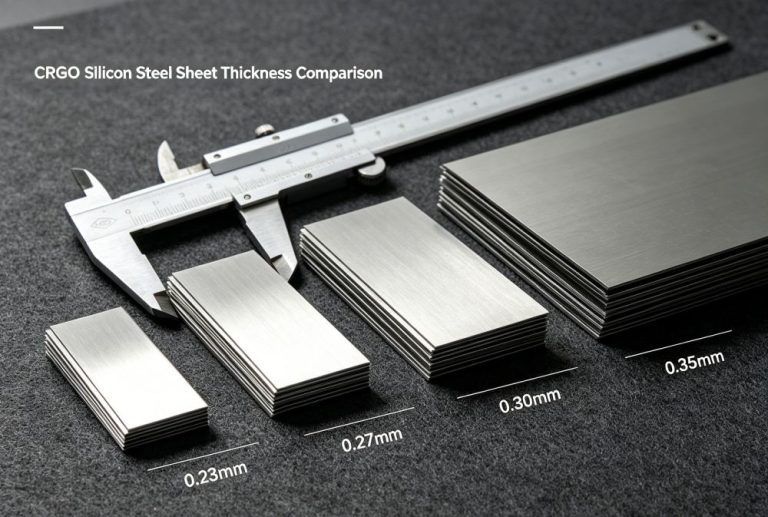
An effective solution is to reliably ground the core, as well as the metal structures, parts, and components that secure the core and windings, so that they are at the same ground potential as the oil tank. The transformer core is grounded at a single point, and must be grounded at a single point only. Since the silicon steel laminations of the core are insulated from one another—a measure designed to prevent the generation of large eddy currents—it is absolutely essential not to ground all the laminations or to use multiple grounding points. Otherwise, significant eddy currents will be generated, causing the core to overheat severely.
Typically, grounding the transformer’s core involves grounding any single silicon steel lamination. Although the laminations are insulated from one another, their insulation resistance is very low. Uneven strong electric and magnetic fields can cause high-voltage charges induced in the laminations to flow through them from the grounding point to ground, while preventing eddy currents from flowing from one lamination to another. Therefore, grounding any single silicon steel laminate in the core is equivalent to grounding the entire core.
It is important to note that the transformer core must be grounded at a single point; it must not be grounded at two points, and certainly not at multiple points, as multiple grounding points is one of the common causes of transformer failure.
■ Why the transformer core must not be grounded at multiple points.
The reason the transformer core laminations can only be grounded at a single point is that if two or more points are grounded, a loop may form between the grounding points. When the main magnetic flux path passes through this closed loop, circulating currents are generated, causing internal overheating and leading to accidents. The melted sections of the core can create short circuits between the laminations, increasing iron losses. In severe cases, this can significantly impair the transformer’s performance and normal operation, requiring replacement of the silicon steel laminations to repair the damage. Therefore, transformers must not be grounded at multiple points—they can have only one grounding point.
■ Multiple grounding points can easily lead to circulating currents and overheating.
During operation, the transformer’s core, clamps, and other metal components are subjected to strong electric fields. Electrostatic induction generates a floating potential on the core and metal parts, and this potential may discharge to ground—which is, of course, unacceptable. Therefore, the core, clamps, and other metal components must be properly and reliably grounded (with the exception of through-bolts). The core is permitted to have only a single grounding point. If there are two or more grounding points, the core will form a closed circuit with the grounding points and the earth. When the transformer is in operation, magnetic flux will pass through this closed circuit, generating what is known as circulating current, which causes localized overheating of the core and may even burn out metal components and insulation layers.
In summary: A transformer’s core must be grounded at only one point; it must not be grounded at two or more points.








Voluptatem perspiciatis nihil id ea dolores nostrum non velit. Sequi sequi et aperiam ex
Facere sed et alias sequi aliquam quia voluptatem perferendis. Est quisquam animi blanditiis non est quos aut. Est sunt et quia qui tempora. Nobis eius quas nihil sit veritatis accusamus. Facilis iste sed aut et. Cumque quibusdam odit eaque dolores similique. Officia recusandae et qui asperiores fugiat repudiandae.
Dignissimos est vero odit nulla. Iusto eius eos ut magni et dolorum