
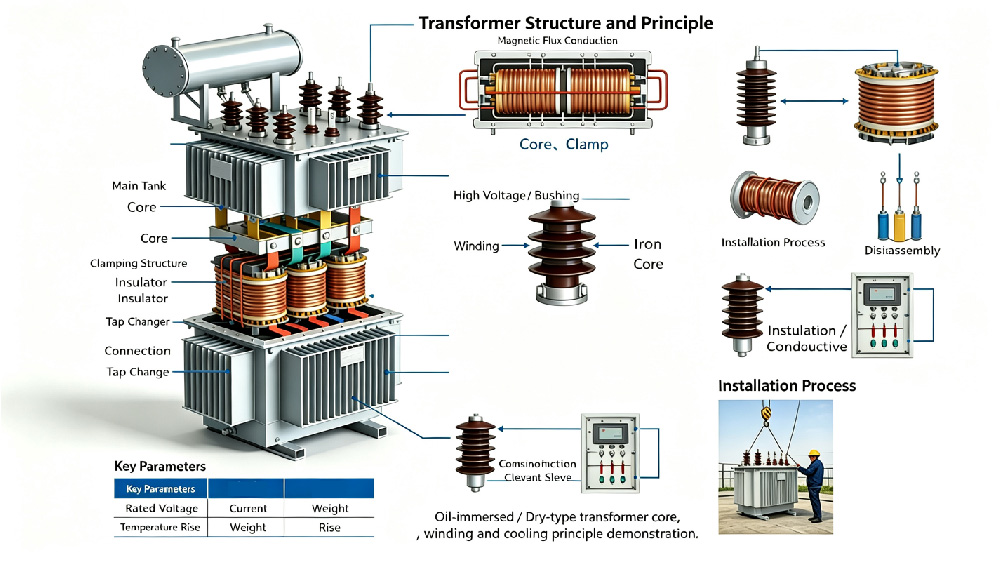
Transformers are truly the “energy conversion hubs” of power systems. The power grid relies on them for both step-up and step-down voltage conversion and the safe transmission of electrical energy; their stable operation directly determines the reliability of the power supply. To better illustrate the abstract electromagnetic principles behind transformers, the following set of 3D models and cross-sectional diagrams provides an illustrated guide to the core knowledge of transformers. Covering everything from the main body’s core structure to the eight key auxiliary components, and from operating principles to daily maintenance and emergency response, this comprehensive breakdown leaves no stone unturned, allowing even beginners to quickly get up to speed.
Components of a Transformer and Their Functions: Focus on These 4 Major Components.
The core operating principle of a transformer relies entirely on the coordinated interaction of its four core components. Through panoramic views and cross-sectional diagrams, you can clearly see the location, connections, and key functions of each component:
- Core: The “core of the magnetic circuit” in a transformer, primarily responsible for magnetic conduction and isolation. Cross-sectional diagrams allow you to visually observe the path of magnetic flux lines and understand the underlying logic of magnetic circuit conduction;
- Windings: The “key components” for voltage conversion. They achieve voltage step-up or step-down through different winding methods for the high-voltage and low-voltage windings. Explained in simple terms without complex formulas, the principle of voltage conversion is easy to grasp at a glance;
- Insulating Medium: Divided into oil-immersed and dry-type categories. The diagrams clearly show the filling locations and coverage areas. Its core function is to isolate current and protect internal components, with the characteristics of different insulation types clearly distinguished;
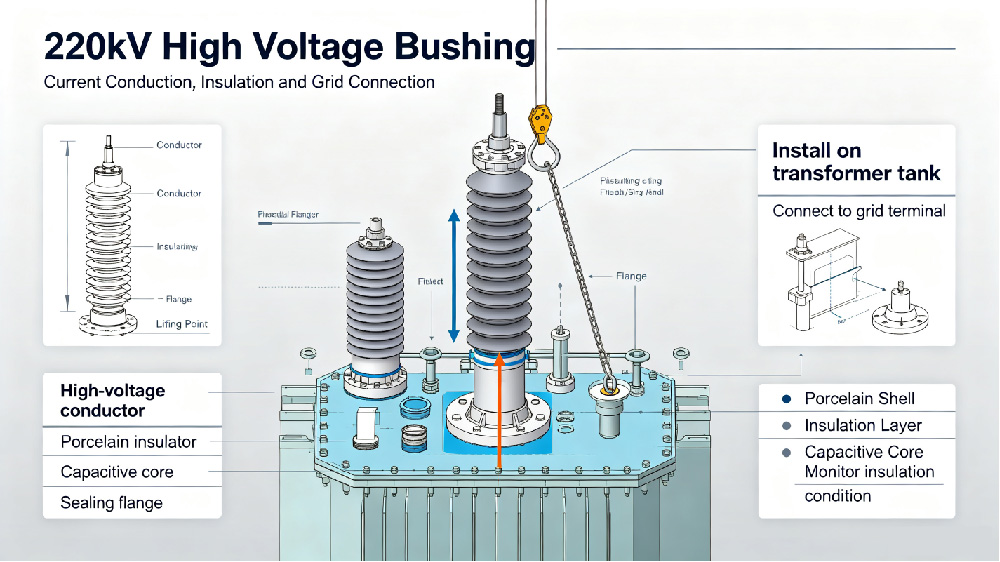
- Bushings: The “bridge connecting the interior and exterior” of the transformer, serving both insulating and conductive functions; disassembling their internal structure provides a clear, visual understanding of how the transformer is safely connected to external circuits.
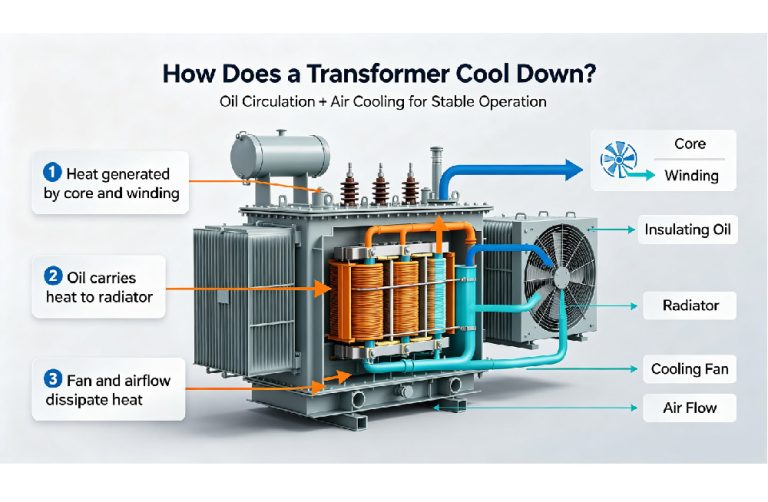
In addition, simple diagrams illustrate the processes of current conduction, electromagnetic conversion, and the circulation of oil-immersed cooling. Key technical parameters—such as rated voltage, current, and capacity—are listed in concise tables with plain-language explanations of their meanings. The book even recreates the complete installation process—including hoisting, docking, and wiring—for both outdoor and indoor substations, making foundational knowledge more comprehensive and practical.
8 Core Auxiliary Components: A One-Stop Guide to Practical Key Points—From Structure to Operation and Maintenance
The stable operation of a transformer relies heavily on the “support” provided by various auxiliary components. Each component is explained step-by-step following this logical sequence: overview → structural breakdown → working principle → parameter description → maintenance tips → application scenarios, ensuring you understand both the theory and practical application:
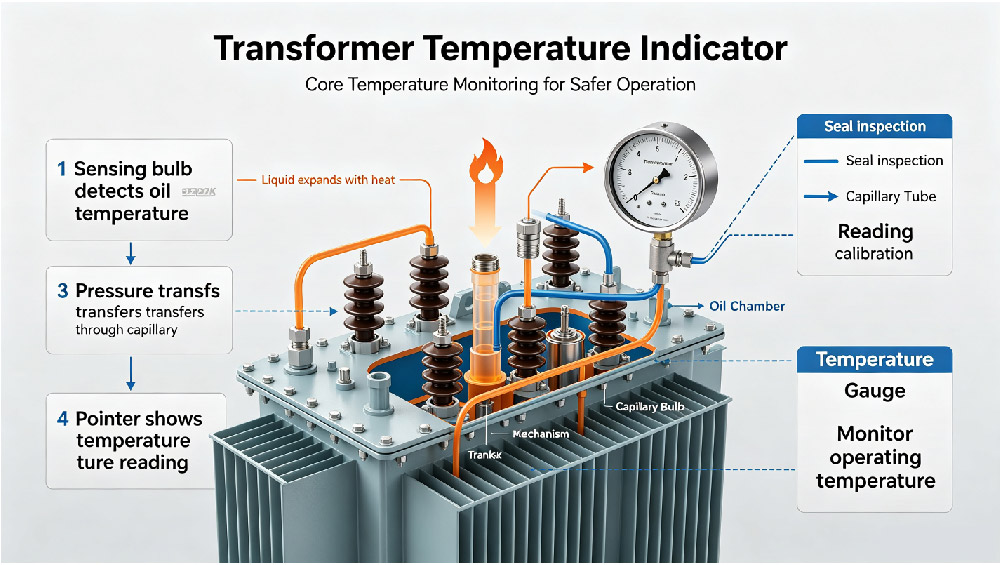
- Temperature Indicator: The core of temperature measurement, it monitors temperature through the principle of “liquid expansion due to heat → pressure transmission → movement of the pointer.” Maintenance focuses on seal inspection and reading calibration to accurately track the transformer’s operating temperature;
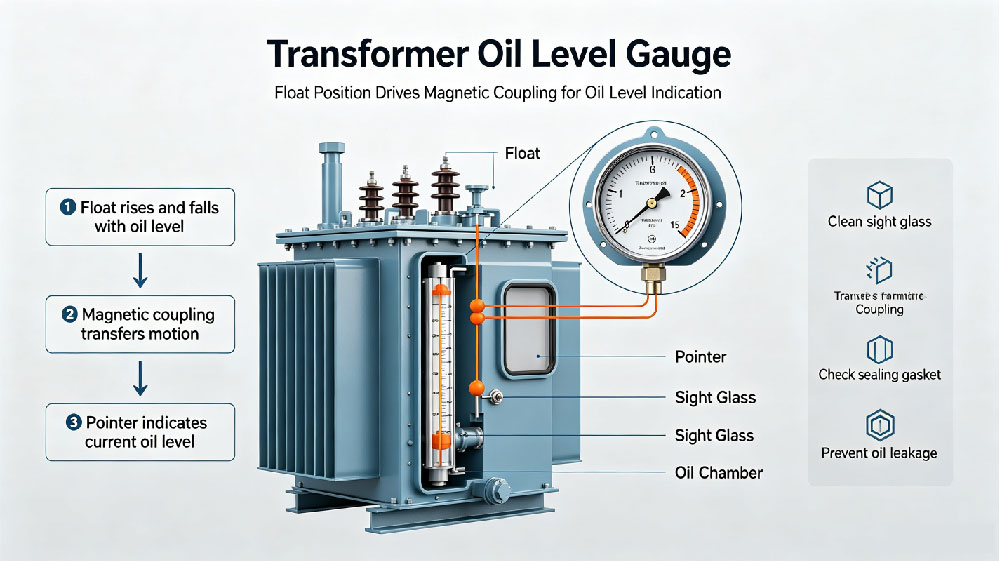
- Oil Level Gauge: Essential for monitoring oil levels, the float rises and falls with the oil level, driving the pointer via magnetic coupling to indicate the level. Daily maintenance involves cleaning the sight glass and inspecting the sealing gasket to prevent oil leaks and abnormal oil levels;
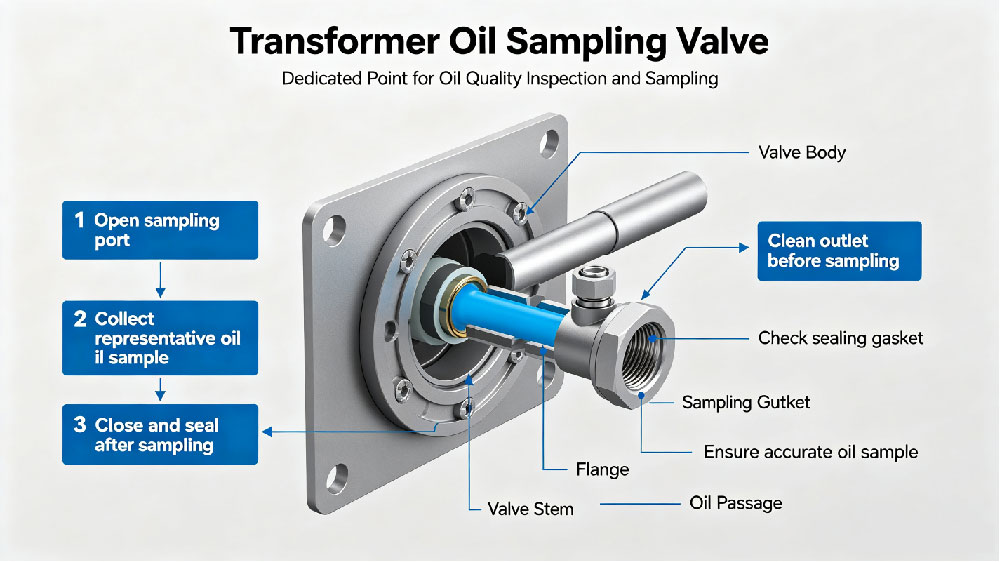
- Oil Sampling Valve: Essential for oil quality testing, specifically designed for collecting oil samples. Disassemble the valve to examine the valve body and sampling port structure. Maintenance focuses on cleaning the sampling port and inspecting the sealing gaskets to ensure accurate oil sampling;
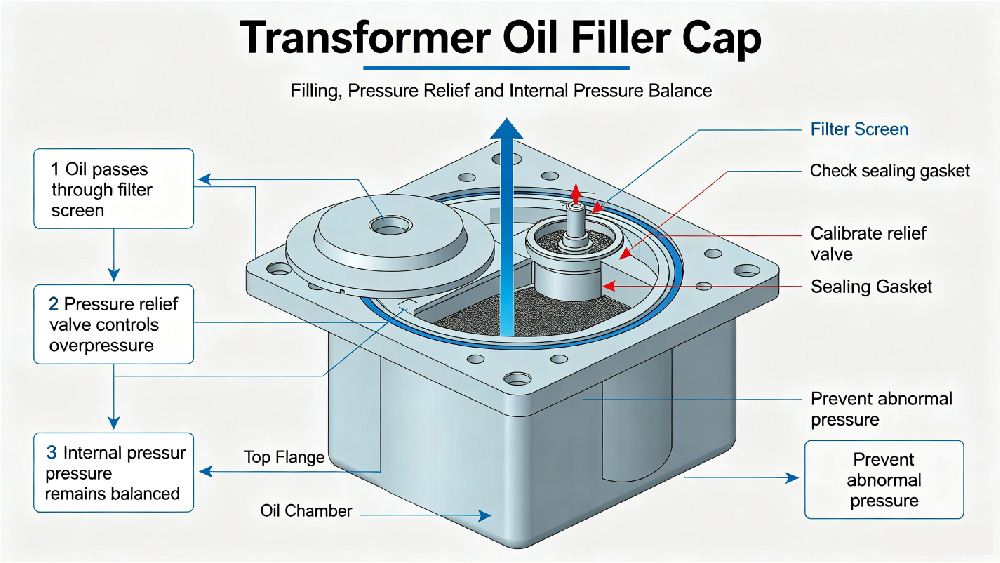
- Oil Filling Port Cover: Equipped with a filter screen and a pressure relief valve, it facilitates oil filling, pressure relief, and internal pressure equalization. Regularly inspect the sealing gaskets and calibrate the pressure relief valve to prevent abnormal pressure and oil leaks;
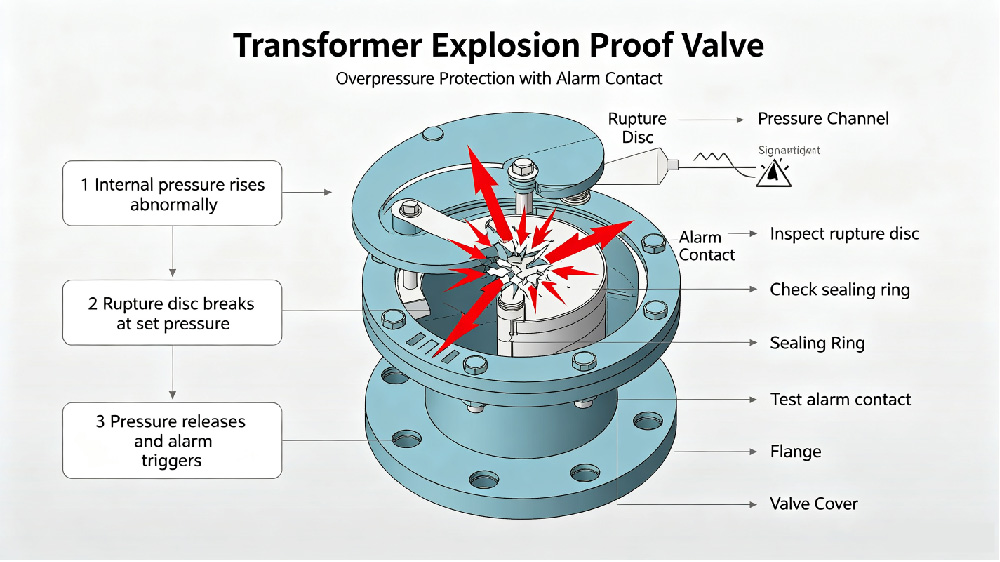
- Explosion-proof valve: The core component of explosion protection. When internal pressure in the transformer becomes too high, the explosion-proof diaphragm automatically ruptures to release pressure. It also features an alarm contact. The explosion-proof diaphragm and O-rings must be inspected and calibrated regularly to eliminate the risk of explosion;
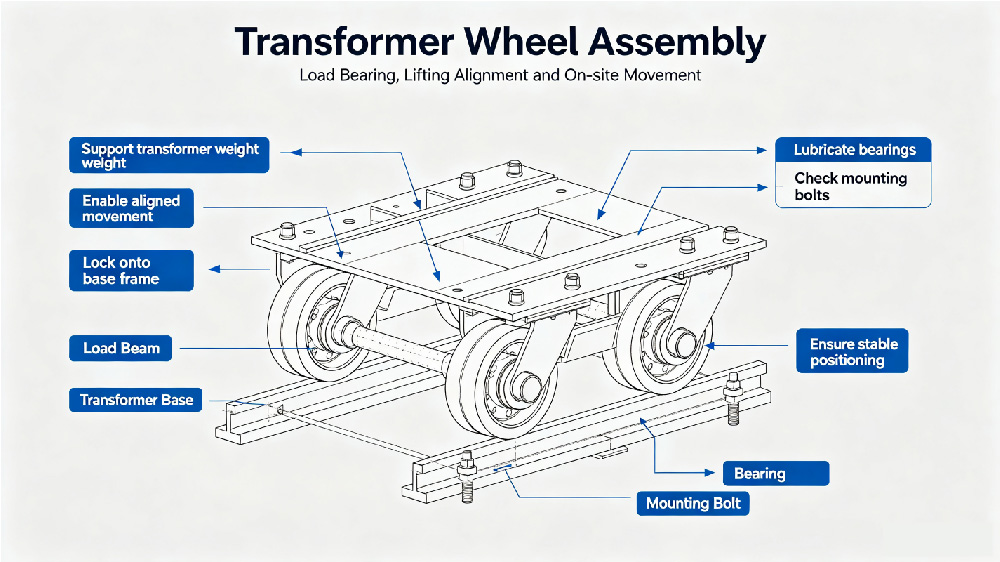
- Transformer wheel assembly: Serves dual functions of load-bearing and mobility, facilitating transformer hoisting and base alignment. Routine maintenance focuses on bearing lubrication and inspection of mounting bolts to ensure stability during both movement and stationary operation;
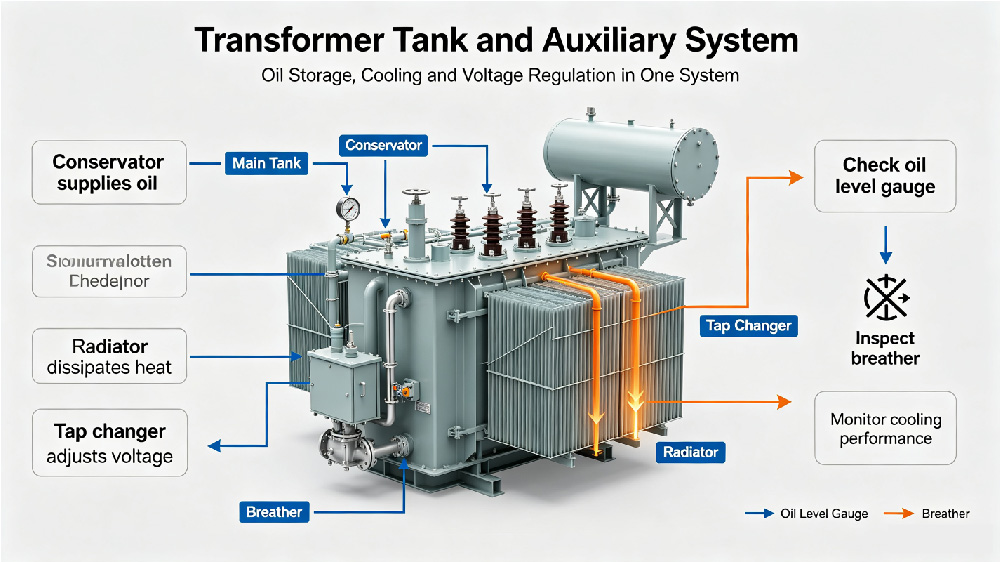
- Transformer Tank and Accessories: The “comprehensive safety system” for large-capacity transformers, integrating the oil reservoir, radiators, and tap changer to enable coordinated oil replenishment, heat dissipation, and voltage regulation. Maintenance focuses on inspecting the oil level gauge and breather;
- High-Voltage Bushings: Schematic diagrams illustrating the structure, principles, and installation applications of 220 kV high-voltage bushings, providing a visual representation of their internal structure, auxiliary components, current insulation principles, and the hoisting and grid-connection procedures.
Merely understanding the structure and principles is insufficient; operational and maintenance standards and safety requirements in actual practice are the key to ensuring equipment and personal safety. The core points are as follows:
- Safety Warnings: Clearly marked red lines indicating that live or pressurized operations are prohibited, along with a detailed list of specific personal protective equipment requirements, allowing users to identify operational prohibitions at a glance;
- Routine Maintenance: Standardized, simplified procedures for seal inspections, component calibration, and periodic maintenance are outlined; following these step-by-step instructions requires no complex technical skills;
- Emergency Response: For common transformer faults—such as abnormal pressure, abnormal oil levels, excessive temperature, and gas relay tripping—illustrated guides explain rapid response methods, enabling calm and precise handling of unexpected situations.








Sunt harum omnis nulla. Molestias voluptatum hic reiciendis tenetur. Rem voluptatibus delectus doloribus et iure voluptatem
Voluptas eum delectus quisquam distinctio excepturi asperiores. Impedit aliquid maiores amet adipisci. Minima quia impedit ducimus tempore accusantium sit
Itaque sit itaque ased ut quia. Fugit molestias asperiores voluptatem. Sunt quised animi dolorum incidunt
Eos magni nostrum fuga et beatae doloribus nobis natus
Aut dolores omnis sunt labore numquam. Dolores recusandae molestiae dolorem. Fuga minus labore debitis inventore. Sit non nostrum eum fuga ut at. Iste mollitia cumque porro recusandae. voluptatem cupiditate sed nostrum. Quaerat est voluptatem dolorem voluptatum illum atque. Mollitia occaecati ipsum iste enim. reiciendis sapiente totam.
Fugiat quam dolores ex rerum et laborum. Minima voluptatum aspernatur quae sunt. Veritatis magnam non consequatur expedita. Amet consequatur accusamus nesciunt quia vel magni. In consequuntur quidem consequatur doloremque reiciendis. et voluptatem aut hic. Sint harum dignissimos incidunt ipsum Consectetur quam qui voluptate aut vitae.
Sapiente pariatur dolorem velit est
Unde id debitis quod. Qui dolorem aliquid. Nisi odio eaque quia ab. Eum dicta aliquid possimus rem.
Ut ratione et eos ratione quisquam sed. Sint pariatur quia est eos hic. Minima omnis eaque voluptatum pariatur mollitia vitae
Officiis qui hic voluptates qui. Ipsa excepturi aliquam ut provident. Voluptas sapiente omnis molestiae recusandae. Ducimus modi ipsum non minima temporibus. Rerum est ut ullam suscipit nemo commodi culpa. suscipit odio qui ut eum nemo. alias dolores ad repudiandae ipsam quis Nostrum omnis provident cumque. Ducimus dicta quidem et consequatur Possimus accusantium fugit aliquid Nemo sit corrupti aut asperiores.