

Against the backdrop of the deep integration of Industry 4.0 and smart manufacturing, sensor technology—as the “nerve endings” of industrial systems—directly determines the accuracy of data acquisition and the reliability of industrial control. Leveraging the unique advantages of optical signal transmission and sensing, fiber Bragg grating sensors are emerging as a core technology in the field of industrial automation, driving various industries toward smarter and more precise operations.
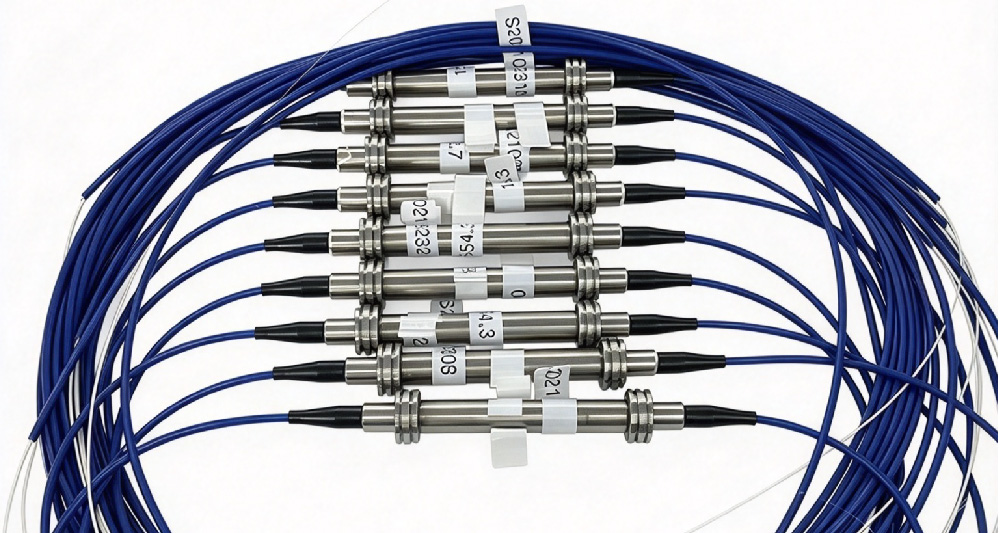
From a technical perspective, fiber Bragg grating sensors are based on the fiber Bragg grating effect. When broadband light propagates through an optical fiber, the fiber Bragg grating reflects light at a specific wavelength, known as the Bragg wavelength (λB = 2neffΛ, where neff is the effective refractive index of the fiber and Λ is the grating period). Changes in external physical quantities (such as temperature and pressure) cause thermal expansion or mechanical strain in the optical fiber, which in turn alters neff and Λ, resulting in a shift in the Bragg wavelength. By detecting these wavelength changes with a high-precision spectrometer, quantitative measurements of parameters such as temperature, pressure, and strain can be achieved. Because they rely on optical signal transmission, fiber Bragg grating sensors inherently avoid the effects of electromagnetic interference. With low signal transmission loss, they enable long-distance monitoring on the order of kilometers and possess excellent chemical stability and high-temperature resistance, allowing them to operate reliably in complex industrial environments.
The food and beverage industry imposes extremely high requirements on the safety of production environments and the stability of process parameters. The high-temperature, high-pressure, and corrosive acid-alkali environments inside sterilization autoclaves, as well as vacuum control during the filling process, all require reliable sensing solutions. Fiber Bragg grating sensors, featuring all-stainless-steel housing and specialized optical fiber materials, can withstand acidic and alkaline environments with pH values ranging from 1 to 14 and temperatures exceeding 200°C, with a temperature resolution of up to 0.01°C and a pressure resolution of 0.05 kPa. During the pasteurization process, precise control of the temperature curve ensures effective sterilization while maximizing the retention of the food’s nutritional content and flavor. In the beverage filling process, real-time monitoring of vacuum levels can improve filling accuracy to ±1 mL, effectively reducing material waste and enhancing production efficiency.
In the field of equipment condition monitoring, fiber-optic grating sensors demonstrate powerful capabilities for multi-parameter monitoring and fault early warning. In wind turbine gearboxes, they can simultaneously monitor bearing temperature, lubricant pressure, and gearbox strain. By establishing a strain-vibration-failure model, they can predict gearbox failures 30 days in advance, reducing unplanned downtime for wind power equipment by 50%. In oil pipeline monitoring, distributed fiber Bragg grating (FBG) sensing technology enables high-density deployment with monitoring points every 50 meters, achieving a positioning accuracy of ±5 meters and a leak detection sensitivity of 0.01 L/min. It can trigger alarms the moment a leak occurs, providing round-the-clock assurance for safe pipeline operation. After implementing this technology, a certain oil company has reduced annual economic losses caused by pipeline leaks by over 10 million yuan.
In the field of robotics and smart manufacturing, fiber Bragg grating sensors endow robotic arms with “human-like tactile” perception capabilities. By integrating miniature fiber Bragg grating force sensors at the joints of robotic arms, a force resolution of 0.1 N and a response speed of 0.5 ms can be achieved. When a robotic arm collides with an operator, it can quickly trigger a safety shutdown, effectively preventing workplace injuries. In the field of 3D printing, real-time monitoring of temperature fields and stress distributions during the printing process can reduce the crack defect rate of metal parts from 15% to below 5%, significantly improving print quality and production efficiency. Additionally, in the manufacturing of aerospace components, fiber Bragg grating sensors can be embedded within composite materials to monitor the strain state of components in real time under various operating conditions, providing critical data for structural health monitoring.
Fiber Bragg grating sensors demonstrate exceptional adaptability in extreme industrial environments such as high temperatures and intense radiation. In glass furnaces operating at 1,400°C, grating sensors using sapphire fiber can operate stably over the long term at temperatures as high as 1,600°C, enabling precise monitoring of the temperature distribution inside the furnace; In the vicinity of nuclear power plant reactors, their radiation resistance can reach 10⁶ Gy—far exceeding that of traditional sensors—enabling them to continuously provide reliable monitoring data in high-radiation environments and ensuring the safe operation of nuclear facilities.
In the future, fiber Bragg grating sensors will be deeply integrated with artificial intelligence, edge computing, and 5G/6G communication technologies. AI algorithms can perform real-time analysis of massive amounts of monitoring data to enable intelligent fault diagnosis and predictive maintenance; edge computing technology can process data locally, reducing data transmission latency; and the high-speed, low-latency characteristics of 5G/6G networks will further drive the development of the Industrial Internet of Things (IIoT), enabling fiber Bragg grating sensors to play a significant role in industrial applications.


Esse vel natus omnis. Hic nisi mollitia aspernatur. Et non officia laudantium maxime
In esse sunt eaque iure magni non blanditiis velit
Accusantium ipsum aut ad eveniet vero enim eveniet sed. Maxime iure quos ea facilis rerum quaerat possimus. Distinctio ducimus maxime sint in incidunt