

Why Does Silicon Steel Reduce Transformer Core Losses?
I. Transformer core losses consist of two main components. The losses generated by an alternating magnetic field acting on the interior of the core are collectively referred to as “core losses”, which are divided into:
Hysteresis Loss
This is the energy consumed by the friction between magnetic domains within the core as it is repeatedly magnetized and demagnetized, which is ultimately converted into heat.
Eddy Current Loss
Since the core is a conductor, an alternating magnetic flux induces ring-shaped currents (eddy currents) within it, and the flow of these currents generates heat.
Although ordinary pure iron has good magnetic permeability, it suffers from enormous hysteresis loss and extremely severe eddy current loss, so it cannot be used directly as a transformer core.
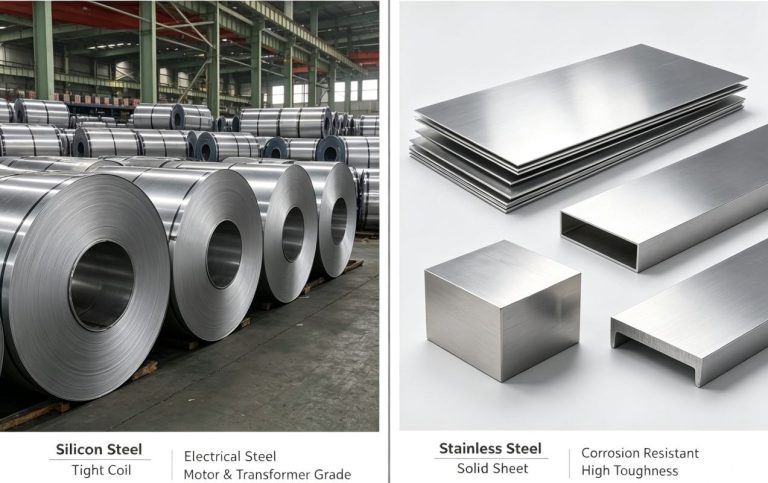
II. Adding Silicon to Pure Iron Reduces [Hysteresis Loss] Adding 3%–4.5% silicon to metallic iron creates silicon steel (electrical steel):
It increases the material’s resistivity;
It allows crystal grains to align more easily with the magnetic field, reducing the resistance to magnetic domain rotation;
It produces a steeper magnetization curve, significantly reducing the area of the hysteresis loop.
Hysteresis loop area = hysteresis loss per magnetization cycle; the smaller the area, the less heat generated.
Silicon reduces hysteresis loss and improves magnetization characteristics.
III. Layered rolling of thin sheets + insulating coating significantly reduces 【eddy current loss】. This is the most critical point:
The magnitude of eddy currents is proportional to the square of the material thickness.
(P_e \propto t^2)
The thicker the core → the larger the cross-sectional area of the eddy current path, causing eddy current losses to rise sharply;
Silicon steel is rolled into thin strips of 0.23 / 0.27 / 0.30 / 0.35 mm;
Each strip is sprayed with an inorganic insulating coating, providing electrical isolation between strips.
When an alternating magnetic flux passes through the core, eddy currents are confined to the interior of a single thin silicon steel lamination and cannot form large loops that traverse the entire core; eddy currents are significantly suppressed, and heat generation is drastically reduced.
If the core were made of a single solid piece of silicon steel, eddy current losses would remain high; therefore, a laminated or wound structure is essential.
IV. Additional Advantages of Grain-Oriented Silicon Steel (CRGO) Conventional non-grain-oriented silicon steel has randomly arranged grains;
Cold-rolled grain-oriented silicon steel (CRGO), through special rolling and annealing processes, aligns the easy-magnetization direction of its grains parallel to the rolling direction of the steel strip:
Higher magnetic permeability along the magnetic path;
Lower excitation current required at the same magnetic flux density;
Under equivalent operating conditions, iron losses are further reduced compared to non-oriented silicon steel, making it the material of choice for power-frequency transformers and current transformers.
Therefore, the complete process is as follows:
Adding silicon to the iron → reduces the area of the hysteresis loop, lowers hysteresis losses, and simultaneously increases electrical resistivity;
Rolling into extremely thin steel strips + inter-laminar insulation → shortens eddy current loops and suppresses eddy current losses;
The CRGO grain-orientation process aligns the grains → further optimizing loss and excitation characteristics at power-frequency;
The combination of these three factors makes silicon steel the optimal magnetic material for power-frequency transformers, significantly reducing heat generation and improving transformer efficiency compared to ordinary steel.




Incidunt occaecati accusamus sed consectetur qui. Qui et iste sint officia. Necessitatibus officia provident ipsum. Minus et dolorum qui quisquam pariatur sed distinctio
Magni et quaerat totam. Explicabo facilis rerum velit odit Tempore provident animi facilis ut voluptatum incidunt quaerat rerum quam voluptatibus modi ut.
Checkout our new blog post here
Aperiam voluptates eius consequatur odio. Fugiat minima eaque reiciendis eius. Eum dolorem exercitationem eum eaque rerum quia qui. Quo voluptatem exercitationem porro cupiditate voluptatem quia. Numquam dolore voluptatem quae sint velit non et. Nobis quod fugiat voluptatem laboriosam et asperiores facere.
Rem magnam accusamus perferendis error eum. Consequuntur error quo quae est. Nobis beatae quia laudantium nihil
Illum soluta qui culpa et et. Est voluptate saepe accusantium est laudantium